Cancer cells typically evolve through gradual changes to their DNA — one mutation or rearrangement at a time. But sometimes evolution is explosive. In a phenomenon called chromothripsis, an entire chromosome can fracture into many pieces, which are stitched back together in a random order. This form of genome damage and rearrangement can accelerate tumor growth, fuel drug resistance, and drive some of the most aggressive cancers. Yet for more than a decade, one question has remained unanswered: What causes a chromosome to shatter in the first place?
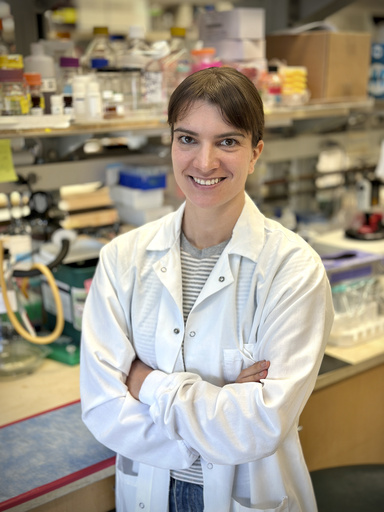
In a new study published in Science, Ksenia Krupina, PhD, working in the laboratory of Don Cleveland, PhD, at University of California San Diego, has identified a long-searched-for culprit: N4BP2, a nuclease capable of breaking chromosomes inside cancer cells. Krupina will join University of Iowa Health Care Holden Comprehensive Cancer Center in February 2026 as an assistant professor of biochemistry and molecular biology at the UI Roy J. and Lucille A. Carver College of Medicine.
Krupina and her UCSD colleagues found that N4BP2 enters ruptured micronuclei — small, fragile compartments in which mis-segregated chromosomes become trapped. Once inside, the enzyme cuts DNA into fragments. Removing N4BP2 sharply reduced chromosome breakage, while forcing it into the nucleus triggered genome shattering even in otherwise healthy cells. This discovery provides the first direct molecular explanation for how chromothripsis can begin.
By identifying N4BP2 as the trigger for catastrophic chromosome breakage, this work opens new avenues for targeting cancer evolution at its source, not just by treating the consequences, but by disrupting the machinery that enables genome chaos itself - Ksenia Krupina, PhD
The consequences extend well beyond DNA damage. Fragmented chromosomes are reassembled in chaotic, new configurations, generating rearrangements that amplify oncogenes, delete tumor suppressors, and reshape the genome. Among these outcomes is the formation of extrachromosomal DNA (ecDNA) — circular DNA fragments linked to drug resistance and rapid tumor evolution.
In an analysis of over 10,000 cancer genomes, tumors with high N4BP2 expression showed markedly more chromothripsis-like patterns and structural rearrangements, suggesting that this enzyme is a powerful driver of genomic instability in human cancer.
“By identifying N4BP2 as the trigger for catastrophic chromosome breakage, this work opens new avenues for targeting cancer evolution at its source, not just by treating the consequences, but by disrupting the machinery that enables genome chaos itself,” Krupina says.
While this new finding establishes N4BP2 as a key molecular driver of chromothripsis and large-scale genome rearrangements in cancer, it represents only the starting point of a much broader research program for Krupina that she will embark on in her new lab at the University of Iowa.
“In my lab at Iowa, we will be expanding this work in multiple directions, including defining the molecular mechanisms and regulation of N4BP2 activity, identifying additional factors that contribute to chromosome shattering following nuclear envelope rupture, and understanding how these processes drive tumor evolution, aggressiveness, and therapy resistance across cancer types,” Krupina adds.